
Time-resolved transcriptomic drug discovery
QUANTRO defines a new state of the art in time resolved transcriptomic drug discovery, using nascent mRNA metabolic labelling to directly measure drug-induced changes in transcriptional dynamics at any point in time.
The problem
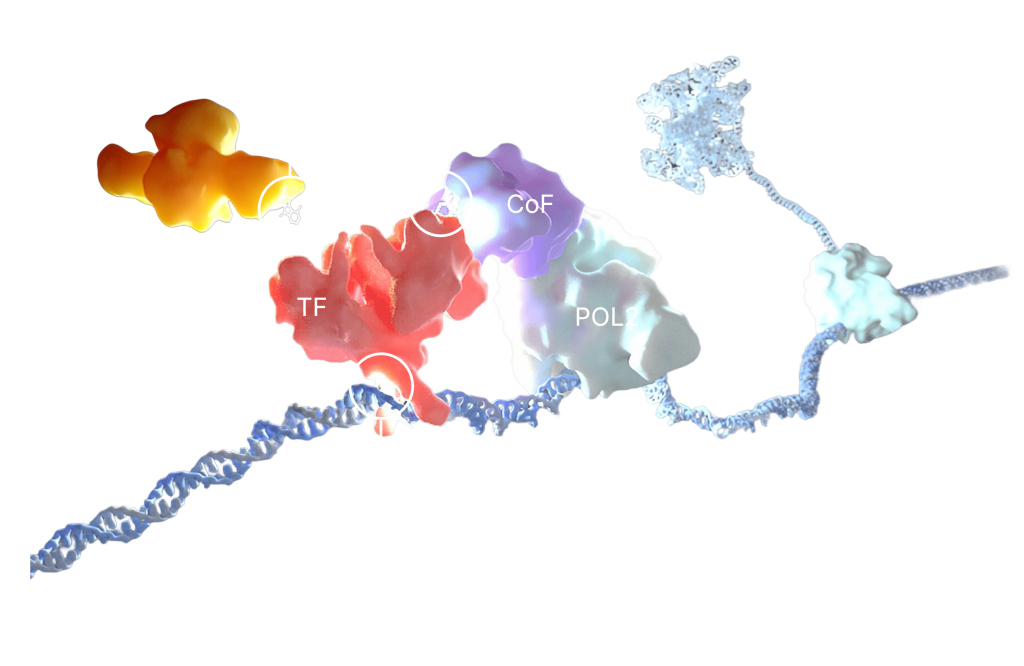
Transcription factors are challenging to drug
Transcription factors sit at the centre of disease biology, yet their structural complexity and the lack of assays that directly measure their function have rendered them difficult to drug.
Undruggable
Target complexity
Transcription factors and their associated proteins defy rational drug design because they are intrinsically disordered and function in complex, multi-protein assemblies.
Invisible
Lack of assays
Current methods cannot precisely measure changes in transcription, leaving the function of transcription-factor-targeting drugs invisible.
Why existing methods fall short
Changes in transcription occur in minutes
Drug-induced changes in transcriptional dynamics cannot be determined with conventional RNA-seq-based methods.
The problem with RNA-seq
- StaticRNA-seq measures mRNA abundance, a steady-state snapshot, not active transcription.
- LaggingWith a median mRNA half-life of ~8 hours, only late changes become visible.
- AmbiguousBy then, direct and indirect effects on transcription can no longer be distinguished.
To overcome the limits of conventional RNA-seq and identify transcription-factor-targeting drugs, QUANTRO developed a scalable, time-resolved transcriptional assay.
QUANTRO core technology
SLAMseq® metabolic labelling makes transcriptional dynamics measurable
SLAMseq® allows measuring the exact ratio of old to new mRNA, enabling precise, time-resolved analysis of drug-induced changes in transcriptional dynamics.
How SLAMseq® works
Cell culture
Newly synthesised mRNA is labelled with 4sU during a defined one-hour window in living cells.
RNA purified
After cell lysis, the labelled RNA is chemically alkylated and reverse-transcribed into single-stranded cDNA. During reverse transcription, the RT enzyme reads alkylated 4sU as C, inserting a G in the cDNA instead of the usual A.
Sequencing
Old and new mRNA are now distinguishable: T-to-C conversions in the sequencing data mark newly synthesised mRNA against a background of pre-existing mRNA.
Platform workflow
From target biology to validated compounds
QUANTRO combines target degradation with time-resolved transcriptomics to create a searchable, target-specific transcriptional fingerprint for compound discovery.
01
Create the reference
Degron engineering & target degradation
Engineer the target for rapid, controlled degradation and measure the immediate transcriptional response.
02
Define fingerprint
Time-resolved transcriptomics
Identify the primary-response genes that define the target-specific transcriptional fingerprint.
03
Screen
Assay development, screen
Develop the assay and screen compound libraries for molecules that reproduce the fingerprint.
04
Hit validation
Validate and characterise hits
Validate selected hits across the full transcriptome and characterise their selectivity and mechanism.
QUANTRO´s transcriptomic platform
QUANTRO’s transcriptomic HTS assays
Different assays for different purposes, balancing information depth and throughput across the discovery process.
Three assay formats compared. QUANTROsens: pre-screen, 3 genes · readout, Up to 150,000 compounds per month, HTS pre-screen. Preliminary selectivity. Dual target genes + control.. QUANTROseq®: multiplex, 100 genes · readout, Up to 10,000 compounds per month, Multi-purpose assay: multi-target HTS. Mode-of-action-specific hit confirmation assay. Pathway annotation and on/off target specificity.. QUANTROslam®: full depth, 20,000 genes · readout, Up to 1,000 profiles per month, Full-transcriptome profile. Dual use: target gene identification for assay development, and hit-validation screen with full specificity profiling for on/off target..
QUANTROsens
Up to 150,000 compounds per month
RoleHTS pre-screen. Preliminary selectivity. Dual target genes + control.
QUANTROseq®
Up to 10,000 compounds per month
RoleMulti-purpose assay: multi-target HTS. Mode-of-action-specific hit confirmation assay. Pathway annotation and on/off target specificity.
QUANTROslam®
Up to 1,000 profiles per month
RoleFull-transcriptome profile. Dual use: target gene identification for assay development, and hit-validation screen with full specificity profiling for on/off target.
QUANTRO´s discovery platform is suitable for different approaches: large compound libraries for HTS screening, focus libraries originating from rational design, and modality-specific libraries such as covalent binders or molecular glues. It is also complementary to traditional approaches following biophysical binding HTS or chemoproteomics, adding deeper insight on specific functional information and on/off-target specificity.
Function-first transcriptomic drug discovery
QUANTRO takes a function-first approach
Most discovery platforms start from biophysical binding or structure-based design approaches. QUANTRO´s transcriptomic discovery uses target-specific transcriptional responses to select compounds that reproduce the desired functional transcriptional response.
This function-first entry point opens direct access to difficult to drug transcription-factor targets. We successfully implemented compound discovery while remaining agnostic to binding site and mechanism, potentiating the chances to find innovative chemistry modulating these targets´ function.
QUANTRO successfully applies this approach across its proprietary pipeline and partnered drug-discovery programmes.